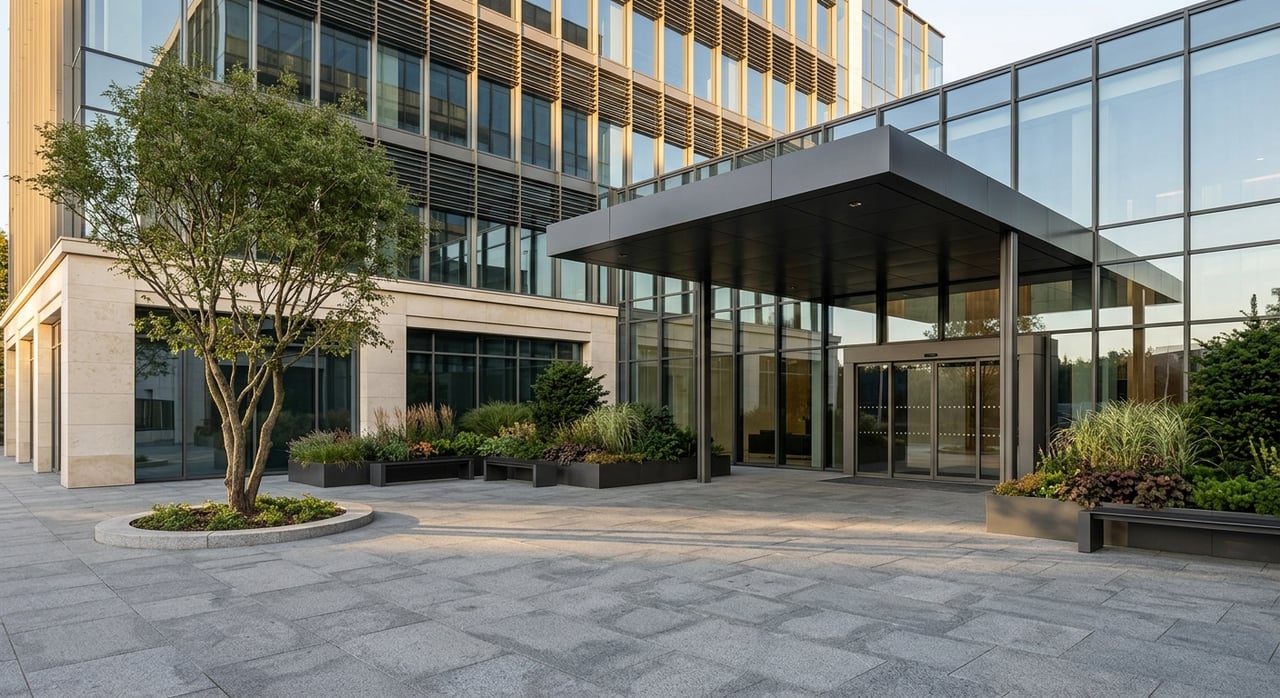
If you evaluate Rosemont like a typical suburb, you can miss what actually drives demand there. In 60018, national tenants are usually not betting on a large residential base. They are evaluating whether a site can capture airport traffic, hotel guests, convention visitors, and weekday workers in one of Chicagoland’s busiest commercial corridors. Let’s dive in.
Why Rosemont Is Different
Rosemont is a small village with an unusually large commercial footprint. According to village materials, it has roughly 4,000 residents, covers about 2.5 square miles, and is about 75% commercial and industrial. The village also reports 75,000 to 100,000 visitors a day.
That changes the way you should think about site selection. In many markets, you start with rooftops and nearby households. In Rosemont, the better starting point is destination demand and whether your concept can convert high-volume visitor and worker traffic into sales.
How National Tenants Define the Trade Area
For many national users, Rosemont is less of a neighborhood retail story and more of an airport-adjacent business district. The village positions Rosemont between O'Hare and Chicago and identifies Higgins Road, River Road, and Mannheim Road as major roads. That location matters because access is central to performance in 60018.
If you are reviewing sites here, the key question is often not just where is the parcel? It is what flow can this parcel capture? A location near airport routes, hotels, convention activity, or office concentrations can perform very differently from a site that depends mostly on internal circulation.
Access Often Leads the Screening Process
Traffic counts help explain why access matters so much in this corridor. In IDOT's 2025 to 2030 program, I-190 at the US 12/45 Mannheim Road interchange is listed at 91,308 annual average daily traffic, while another I-190 segment at the Bessie Coleman interchange is listed at 91,504. The I-190 segment from the Des Plaines River Bridge to River Road is listed at 57,200.
Those are high-volume numbers, and they support what most tenants already suspect when they tour the area. Rosemont is not just a local street network. It is part of a major access system tied to O'Hare, regional employment, and destination travel.
IDOT is also funding a $56.5 million interchange reconstruction at Mannheim along with additional auxiliary-lane work. For tenants, that reinforces the long-term importance of this corridor as a regional gateway.
Not All 60018 Sites Are Equal
A common mistake is to group all Rosemont sites together. In practice, sites near I-190, Mannheim Road, River Road, or Higgins Road can offer a very different exposure profile than locations with weaker visibility or less direct access.
That means a strong map pin alone is not enough. You need to understand how customers actually arrive, how they circulate, and whether your location benefits from drive-by visibility, destination intent, or repeat weekday traffic.
Visitor Demand Drives Much of the Story
Rosemont's demand base is heavily shaped by hotels, conventions, and airport activity. The village says the Donald E. Stephens Convention and Conference Center is nearly one million square feet, hosts about 100 events a year, and draws more than 1.35 million visitors annually.
Hotel supply adds another layer. The village reports 20 hotels, more than 10,000 rooms within 3.5 miles, and about 6,000 rooms within village limits. For many tenants, that creates a steady stream of short-term visitors who need food, services, and convenience-based retail near where they stay.
On the airport side, Airports Council International ranked O'Hare fourth in North America in 2024 with 80,043,050 passengers. The Chicago Department of Aviation says the airport system serves more than 100 million passengers each year, connects to more than 260 locations through 50 carriers to 46 countries, and generates about $70 billion in regional economic activity.
Taken together, those numbers are why many corporate real estate teams view Rosemont as more than a suburban stop. It functions as an airport-linked commercial district with regional and national reach.
Daytime Population Matters More Than Resident Count
If you only look at Rosemont's resident population, the market can appear smaller than it really is. Village materials say more than 60,000 employees commute into Rosemont daily. Combined with the reported 75,000 to 100,000 daily visitors, that points to a strong daytime demand base.
For many users, this is the real engine behind the corridor. Sales can be supported by office workers, hotel guests, event attendees, and airport-related movement even when the full-time residential base is modest.
What That Means for Tenant Types
Different concepts fit different demand streams. A quick-service or convenience-oriented use may rely heavily on freeway visibility and easy in-and-out access. A restaurant or service concept near hotels and convention activity may benefit more from traveler capture.
Office-service uses may perform best where weekday employee concentration is strongest. The point is simple: success in Rosemont usually depends on matching your business model to the right source of traffic.
Rent Benchmarks Matter, but Fit Matters More
Lease economics still have to work. In suburban office, Cushman & Wakefield reported Q4 2025 O'Hare asking rents at $32.98 per square foot overall and $40.06 per square foot for Class A, with 20.5% vacancy. Newmark's 1Q26 report put O'Hare Class A direct asking rent at $34.45 per square foot.
For retail context, Matthews reported a Chicago market-wide average asking rent of $21.94 per square foot in Q3 2025, with 5.6% availability. Those numbers are useful as benchmarks, but they should not be treated as fixed pricing for every Rosemont site.
The bigger underwriting question is whether a specific location justifies its occupancy cost. If a site offers better visibility, stronger traveler capture, or a more reliable weekday base, a higher rent may be justified. If it does not, the deal can look attractive on paper and still underperform in practice.
The Questions National Tenants Usually Ask
When tenants narrow the field in 60018, a few practical questions usually rise to the top. These questions help determine whether a site is worth deeper review.
- Can the site capture I-190 and Mannheim traffic, or does it depend mostly on local circulation?
- Is demand coming primarily from travelers, convention attendees, office workers, or some mix of all three?
- Does the quoted lease structure include expense recovery, tenant improvement assumptions, or parking expectations?
- Will the location still make sense after 5 p.m. and on non-event days?
These are not minor details. They often decide whether a Rosemont opportunity fits your format, budget, and sales model.
How to Evaluate a Rosemont Site More Clearly
If you are comparing multiple sites in the O'Hare corridor, a simple framework can help. Start with access, then move to demand source, then test whether the rent aligns with likely revenue potential.
1. Start With Access and Visibility
Review how directly the site connects to Mannheim Road, River Road, Higgins Road, I-190, and nearby airport routes. A site that is easy to reach and easy to see often has a stronger chance of converting transient traffic.
2. Identify the Primary Demand Driver
Be clear about who your customer is at that location. In Rosemont, that may be a hotel guest, a convention visitor, a commuter, or an office worker rather than a nearby resident.
3. Stress-Test the Dayparts
A site may feel strong during a major event and quiet at other times. You should evaluate whether the location works during weekday lunch, evening hours, and non-event periods.
4. Underwrite the Real Occupancy Cost
Do not stop at base rent. You also need clarity on expense recovery, parking assumptions, tenant improvement expectations, and any build-out issues that could affect timing or total cost.
Why Local Site Selection Guidance Helps
Rosemont can look simple on a map and still be tricky in practice. The corridor has strong demand drivers, but they are not evenly distributed. One site may be built around freeway capture, while another depends on hotel proximity or office traffic.
That is where local market knowledge becomes valuable. A focused advisor can help you compare not just asking rents, but also traffic mix, visibility, circulation, and whether the site matches your concept's real operating needs.
For national tenants and franchisees, the goal is not just to find a vacancy in 60018. It is to find the right vacancy, in the right pocket, with the right access story behind it.
If you are weighing Rosemont or the broader O'Hare corridor for your next location, Rafidia Team can help you evaluate sites with a sharper local lens and a practical understanding of tenant priorities.
FAQs
How do national tenants evaluate Rosemont differently from a typical suburb?
- National tenants often treat Rosemont as a destination and airport-adjacent business district, with demand driven more by visitors, hotel guests, convention traffic, and workers than by the local residential base.
What roads matter most for retail site selection in Rosemont?
- Mannheim Road, River Road, Higgins Road, and access to I-190 are major considerations because visibility and connectivity can shape how well a site captures regional traffic.
Why is daytime population so important in Rosemont, Illinois?
- Rosemont reports more than 60,000 daily commuters and 75,000 to 100,000 daily visitors, which means weekday workers and visitors can support sales even though the village has a small resident population.
What demand sources support tenants near O'Hare and Rosemont?
- Key demand sources include airport passengers, hotel guests, convention attendees, and employees commuting into the corridor for work.
Are rent benchmarks enough to choose a Rosemont commercial site?
- No. Rent benchmarks are useful, but tenants still need to test whether a specific site's visibility, traffic mix, and access are strong enough to justify the occupancy cost.