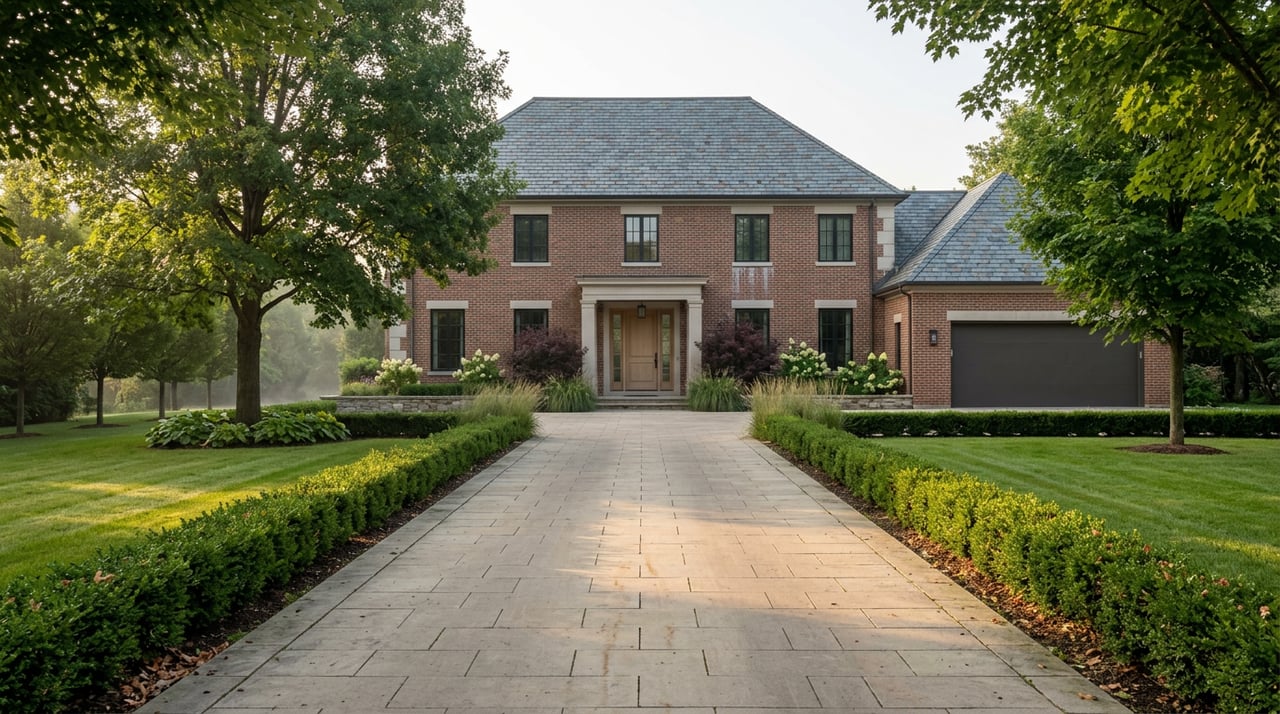
A house in Inverness will run you close to $285,000 more than the median home in nearby Barrington. Compare Inverness's estimated rate per square foot with Barrington's downtown-core rate, though, and the story flips: Inverness comes in lower. That gap between what the sticker price implies and what the math actually shows is the thing worth understanding before you write an offer in either town.
Here is what the three closest reference points look like right now.
| Town | Median Sale Price | Year-Over-Year | Reporting Window |
|---|---|---|---|
| Palatine | $399,782 | +6.3% | June 2026 |
| Barrington | $594,644 | +0.2% | Three months ending May 2026 |
| Inverness | $879,374 | +12.2% | May 2026 |
That's the ladder most buyers already see on the portals: Palatine as the accessible entry point, Barrington as the established middle, Inverness as the top rung. What the table doesn't tell you is why the top rung costs what it costs, and whether that cost buys you a better home or just a bigger one.
The Number the Median Price Skips
Barrington's downtown core sold for about $275 per square foot over the three months ending May 2026, down slightly from the year before. That's a real, transaction-based rate for a walkable village center with a Metra stop, restaurants, and homes on standard in-town lots.
Inverness doesn't have a directly comparable per-square-foot figure from the same source, but you can back into one. Take the town's May 2026 median sale price of $879,374 and divide it by the average Inverness home size of 6,027 square feet, more than triple the county average of 1,925 square feet according to listing data pulled in June 2026. That works out to roughly $146 per square foot, well under Barrington's $275 rate.
This is the part that should reset how you read the median price. Inverness isn't charging you a premium rate for finished interior space. It's selling you more space at a lower rate per square foot, on a much bigger lot. The higher total price comes almost entirely from the size of the house and the size of the parcel underneath it, not from some luxury tax on the square footage itself.
Why the Village Itself Set This Up
This isn't a market quirk. It's written into the village code. Under Inverness's zoning ordinance, most residential parcels fall under the A-1 Residential district, which sets a minimum lot size of one acre and a minimum average lot width of 140 feet. A smaller multi-family designation exists, but the baseline for most of the village is built around the one-acre lot, not the quarter-acre or smaller lots that shape lot sizes in Barrington's walkable core or in much of Palatine.
You can read the exact lot area requirements in Inverness's village code, and it's worth doing if you're comparing towns seriously. The ordinance doesn't just permit large lots. It requires them across most of the village, which is why curving, tree-lined streets with long driveways and generous setbacks are the rule here rather than the exception. Every builder working in Inverness for the past several decades has been building within that constraint, which is a large part of why the average home size runs so far above the surrounding area.
What You Trade for the Acre
None of this means Inverness is a bargain. It means the premium you're paying buys land and structure rather than a rate markup, and that trade comes with its own set of practical considerations worth walking through before you tour a single house.
- Commercial space inside the village is limited. Inverness was planned as a residential community first, so day-to-day errands, groceries, and dining typically mean a short drive into Palatine or Barrington rather than a walk down the block.
- School district assignment varies by address, not by town name. Parts of Inverness are served by Palatine-area elementary and junior high districts, other parts by Barrington-area districts, and high school assignment can fall under Township High School District 211 or Barrington 220 depending on where the parcel sits. Confirm the district for a specific address before you assume anything based on the village name alone.
- Utilities aren't uniform across every lot. Some Inverness properties rely on private septic systems and wells rather than municipal sewer and water. This is worth verifying at the parcel level early in a search, since it affects both due diligence and long-term maintenance planning.
- Acreage parcels are often irregular. A one-acre minimum doesn't mean a uniform one-acre rectangle. A current survey matters more here than it would on a standard subdivision lot, particularly when confirming easements and setbacks.
None of these are reasons to avoid Inverness. They're the specific homework items that separate a buyer who understands what they're purchasing from one who is reacting to a number on a listing page.
A Quick FAQ
Does Inverness have its own downtown business district? Not in the way Barrington or Palatine do. Inverness is built around residential parks, including Maggie Rogers Park, North Park, and South Park, along with the private Inverness Golf Club, rather than a commercial main street. Most retail and dining trips mean a short drive to a neighboring town.
Which school district serves Inverness? It depends on the exact address. Elementary and junior high assignment splits between Palatine-area and Barrington-area districts, and high school assignment can fall under Township High School District 211 or Barrington 220. Always confirm boundaries for the specific parcel rather than assuming based on the village name.
Are Inverness homes connected to municipal sewer and water? Not universally. Some parcels use private septic and well systems. This is a parcel-level question, and it's one worth resolving early since it affects financing, inspection scope, and long-term costs.
Where This Leaves You
If you're comparing Inverness to Barrington or Palatine on price alone, you're comparing three different products dressed up in one column of numbers. Inverness sells acreage and square footage at a rate that, once you account for home size, sits below Barrington's own per-square-foot pace. Barrington sells walkability and a denser, more finished-per-dollar footprint. Palatine sells the lowest entry point on the ladder. None of these is objectively the better buy. Each is a different answer to a different question about what you actually want your money to do.
That's the kind of distinction that's easy to miss scrolling through listing photos and hard to unwind once you're three weeks into a search in the wrong town for your priorities. If you want to work through which of these trade-offs actually fits your situation, acreage against walkability, resale liquidity against privacy, the Rafidia Team can walk the numbers with you against your specific list. Schedule a Private Consultation and we'll start with the town that actually matches what you're trying to buy, not just the one with the biggest yard.
This article is general information, not legal, tax or financial advice. Consult a qualified professional about your situation.